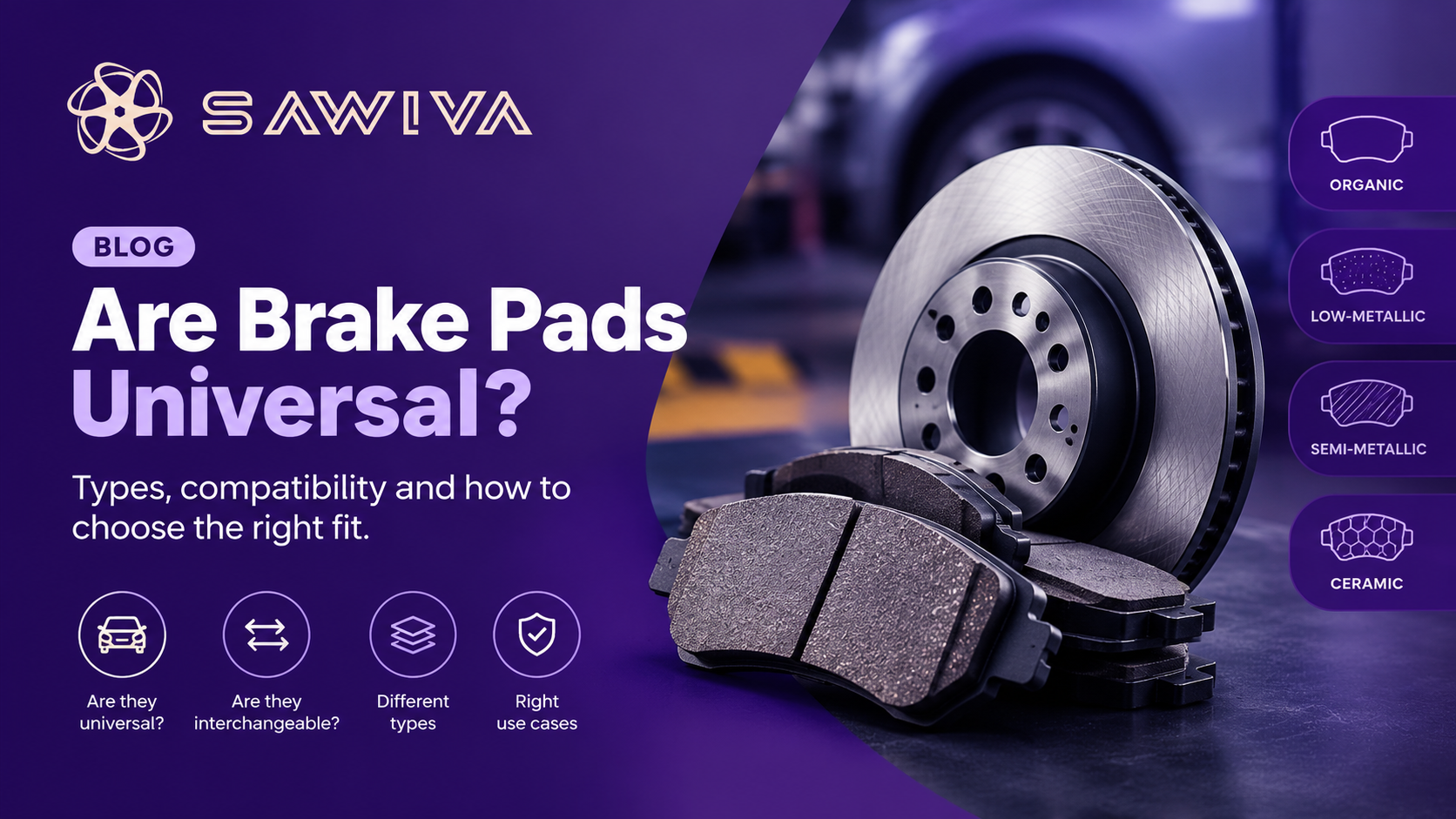
Are Brake Pads Universal? Types, Compatibility and How to Choose the Right Ones
Are brake pads interchangeable? Discover the differences between ceramic, organic, low-metallic and semi-metallic brake pads, their uses, and how to choose the right set for your car.
Post by: Sawiva | 2025-08-06 12:09:42
Introduction: Small Parts, Big Responsibility
Every time you press the brake pedal, several components work together to slow your vehicle down. Among the most important are your brake pads.
Brake pads create friction against the brake discs, also called rotors, helping convert the vehicle's kinetic energy into heat. Without the right pads, your car may struggle to stop smoothly, produce excessive noise, or experience reduced braking performance.
But walk into a spare-parts shop, browse an online marketplace, or ask a mechanic for replacement pads, and you will quickly discover that brake pads come in different shapes, sizes, materials and prices.
This raises three important questions: Are brake pads universal? Can you interchange different types? And which brake pads are best for your vehicle?
Let's break it down.
1. Are Brake Pads Universal?
No. Brake pads are not universal, although the same pad design can fit multiple vehicles.
Brake pads are engineered to work with specific braking systems. Their dimensions, backing-plate shape, friction surface, mounting points and additional hardware must match the vehicle's brake caliper and rotor.
For example, two Toyota models may use different brake pads despite sharing the same manufacturer. Conversely, vehicles from different manufacturers may use compatible pads if their braking hardware and specifications match.
Compatibility depends on the actual brake system, not simply the vehicle brand.
What determines whether a brake pad fits?
-
Vehicle make and model: Different vehicles have different braking configurations.
-
Manufacturing year and variant: The same model may have different brakes depending on its production year, engine, trim or market.
-
Front or rear axle: Front and rear pads are generally different shapes and sizes.
-
Brake caliper and rotor: The pad must fit the caliper correctly and contact the intended rotor surface.
-
Part number: An original equipment (OE) reference or verified aftermarket cross-reference helps identify compatible replacements.
-
Sensors and accessories: Some pads require wear sensors, particular shims, clips or other hardware.
The safest approach is to verify the part number against a reliable parts catalogue using the vehicle's VIN or chassis number.
A pad that looks similar to your old one is not necessarily compatible.
2. Are Brake Pads Interchangeable?
Yes, but only when the replacement is confirmed to be compatible with the vehicle's braking system.
There are two different kinds of interchangeability to understand.
A. Interchanging brake pads between vehicles
A brake pad designed for one vehicle may also fit another if both vehicles use the same compatible brake assembly.
This is common in the aftermarket parts industry, where manufacturers supply a single pad design for several applications.
However, a matching outline alone is not enough. Thickness, friction characteristics, mounting hardware, sensors and manufacturer specifications must also be considered.
B. Interchanging brake pad materials
Suppose your car currently uses a semi-metallic brake pad. Can you replace it with a ceramic one?
Sometimes. A ceramic or other alternative-compound pad may be available for the same vehicle, but it must be explicitly approved for that application.
Different friction compounds can change pedal feel, cold braking performance, heat tolerance, noise and rotor wear. Choosing a different compound simply because it is more expensive or advertised as an upgrade does not guarantee better braking.
Important rule: Replace brake pads in axle pairs, using matching pads on both the left and right wheels of the same axle. Do not mix different pad compounds on opposite sides, as this can create inconsistent braking behaviour.
3. What Are the Different Types of Brake Pads?
Brake pads are commonly classified by their friction material. The main categories are organic, low-metallic, semi-metallic and ceramic or ceramic-style formulations.
Each offers a different balance of braking performance, comfort, durability and cost.
3.1 Organic brake pads (NAO)
Organic pads, also called non-asbestos organic (NAO) pads, use a mixture of fibres, fillers and resins to create the friction material.
They are generally designed to prioritise comfortable, quiet braking rather than extreme heat resistance.
Advantages
-
Generally quiet operation.
-
Often relatively affordable.
-
Can be gentle on brake rotors.
-
Suitable for many light-duty driving applications.
Disadvantages
-
May wear faster under demanding conditions.
-
Can struggle with sustained high temperatures.
-
Performance varies considerably by formulation.
Best use cases: Everyday commuting, lighter vehicles and drivers who prioritise comfort, provided the pad meets the vehicle manufacturer's specifications.
3.2 Low-metallic brake pads
Low-metallic organic pads combine an organic base with a relatively small proportion of metal, often including steel or other metallic ingredients.
The added metal helps modify friction and heat transfer, making these pads a useful option for applications that require a more responsive braking feel.
Advantages
-
Often provide good initial braking response.
-
Can offer improved heat handling over some organic formulations.
-
Available for many passenger cars and light commercial vehicles.
Disadvantages
-
Can generate more brake dust than some organic or ceramic-style alternatives.
-
May produce more noise.
-
Performance depends on the particular formulation.
Best use cases: Everyday driving where a balance of braking response, cost and temperature performance is needed, especially when a low-metallic formulation is specified for the vehicle.
3.3 Semi-metallic brake pads
Semi-metallic pads contain metal fibres or particles combined with other friction materials and bonding agents. The metal content helps the pad manage heat and withstand demanding braking conditions.
They are widely used in applications where durability and consistent performance under heavier braking loads matter.
Advantages
-
Generally good heat resistance.
-
Often suitable for repeated or harder braking.
-
Can offer strong braking performance under demanding conditions.
-
Available in formulations for cars, SUVs, pickups and some performance vehicles.
Disadvantages
-
Can be noisier than comfort-oriented alternatives.
-
May produce more visible brake dust.
-
Can contribute to greater rotor wear, depending on the formulation.
Best use cases: Heavier vehicles, certain SUVs and pickups, demanding road use, towing applications and performance-oriented driving, when the particular pad is approved for that use.
3.4 Ceramic brake pads
Automotive ceramic brake pads use engineered ceramic-based friction materials, often combined with other fibres, fillers and modifiers. They are not simply made from the same ceramic used in household pottery.
Ceramic-style pads are popular with drivers who want quiet braking and cleaner wheels.
Advantages
-
Typically quiet during normal driving.
-
Often produce less visible brake dust.
-
Can provide good everyday braking performance.
-
May offer satisfactory service life in suitable applications.
Disadvantages
-
Often cost more than budget alternatives.
-
Not automatically suitable for extreme heat or racing.
-
May not reproduce the braking characteristics intended by a vehicle manufacturer using a different compound.
Best use cases: Daily commuters, family cars and drivers who value comfort, low noise and reduced visible dust, provided ceramic pads are approved for their vehicle.
3.5 Fully metallic and specialist performance pads
Some motorsport and specialist applications use highly metallic or other high-temperature friction compounds designed for specific operating conditions.
These pads may deliver excellent performance when hot but can behave differently during ordinary road driving, particularly when cold. They may also increase rotor wear and noise.
Best use cases: Track driving, competition vehicles and specialist high-temperature applications with appropriately matched brake components.
They are generally not the default choice for ordinary road cars. A road-legal performance pad designed for occasional spirited driving is not necessarily the same as a dedicated racing pad.
4. Brake Pad Types Compared
| Feature | Organic (NAO) | Low-metallic | Semi-metallic | Ceramic-style |
|---|---|---|---|---|
| Typical cost | Low | Low–medium | Medium | Medium–high |
| Noise | Generally low | Low–moderate | Moderate–high | Generally low |
| Visible dust | Varies | Often moderate–high | Often moderate–high | Often low |
| Heat handling | Application-dependent; often limited under sustained heavy braking | Moderate to good | Generally good | Good for suitable road applications |
| Rotor wear | Often relatively low | Varies | Can be higher | Often relatively low |
| Typical priority | Comfort and cost | Balanced response | Durability and demanding use | Comfort and cleaner wheels |
These are general tendencies, not guarantees. Two pads in the same category can perform differently because their formulations, designs and intended applications differ.
The right pad is the one engineered for your vehicle and driving conditions, not necessarily the one with the most attractive specification on the box.
5. Which Brake Pads Should You Choose?
Your driving environment can help narrow the options, but vehicle compatibility should always come first.
For everyday city driving
Frequent stops, traffic jams and short trips place repeated demands on your brakes. An OE-equivalent organic, ceramic-style or low-metallic pad may be suitable depending on the original specification.
Prioritise predictable cold braking, comfortable pedal response and appropriate wear characteristics.
For highways and long-distance driving
Look for a pad that maintains consistent performance across the temperatures expected during your journey.
If you frequently drive through steep terrain or encounter repeated heavy braking, heat resistance becomes especially important. Do not assume that any ceramic pad is suitable for every highway or mountain-driving condition.
For SUVs, pickups and loaded vehicles
Vehicle mass and payload influence braking demands. If you carry heavy loads, tow a trailer or regularly drive on steep roads, choose a pad specifically rated for those conditions.
A suitable semi-metallic or heavy-duty formulation may be appropriate, but the vehicle manufacturer's specifications remain the starting point.
For performance driving
Repeated high-speed braking produces substantial heat. Select pads designed for your particular brake system and intended operating temperatures.
If you use the same vehicle on public roads and at track events, you may need to balance cold performance, noise, wear and high-temperature capability.
For drivers on a budget
The cheapest pad is not always the most economical option.
Compare the purchase price, expected service life, rotor wear, noise and suitability for your driving conditions. An inexpensive pad that wears quickly or damages other components can cost more over time.
6. How to Identify the Correct Brake Pads Before Buying
Whether you are a car owner, mechanic or spare-parts retailer, follow these steps before ordering a replacement.
Step 1: Identify the vehicle accurately.
Record the make, model, production year, engine or trim, and VIN or chassis number where available.
Step 2: Identify the axle.
Confirm whether the replacement is for the front or rear brakes. Never assume the same pad fits both.
Step 3: Find the original or aftermarket part number.
Use the OE reference or a reputable parts catalogue. Verify any aftermarket cross-reference instead of relying on a product title alone.
Step 4: Confirm the brake configuration.
Some vehicles have multiple brake packages. Check the caliper, rotor and relevant specifications, particularly if the vehicle has been modified.
Step 5: Verify the friction compound and accessories.
Confirm the pad's intended application, required wear sensors, shims and fitting hardware.
Step 6: Inspect the braking system during replacement.
A mechanic should check the rotors, calipers, guide pins and other relevant components. Replacing pads will not fix a seized caliper, damaged rotor or underlying brake-system fault.
Step 7: Follow the manufacturer's installation and bedding-in instructions.
Correct installation and bedding-in help the pads establish their intended contact with the rotor.
7. When Should Brake Pads Be Replaced?
Brake pads wear down over time, but there is no single replacement mileage that applies to every vehicle. Driving habits, traffic, vehicle weight, terrain, pad material and braking-system condition all affect service life.
Common warning signs include:
-
A persistent squealing or wear-indicator sound.
-
Grinding noises, which may indicate that the friction material has worn away.
-
Reduced braking performance or unusual pedal behaviour.
-
A brake-pad warning light on vehicles equipped with the relevant sensor.
-
Visibly thin friction material during inspection.
Some symptoms can indicate problems beyond worn pads. Grinding, a significant change in pedal feel, pulling to one side or reduced braking performance warrants prompt inspection. If braking performance is seriously impaired, stop driving when safe and arrange professional assistance.
Do not wait for a warning sign if the pads are already at the manufacturer's minimum thickness.
8. Common Brake Pad Myths
Myth 1: All brake pads are the same.
Reality: They differ in shape, dimensions, friction compound, accessories and intended application.
Myth 2: If the pad fits physically, it will work.
Reality: Correct fitment also requires compatible friction characteristics, hardware and brake-system specifications.
Myth 3: Ceramic pads are always better.
Reality: Ceramic-style pads can offer excellent comfort and low visible dust, but a different compound may be more suitable for a particular vehicle or demanding use.
Myth 4: More expensive pads always stop a car faster.
Reality: Price alone does not establish stopping performance. Vehicle compatibility, tyre grip, rotor condition, brake-system design and the pad's friction characteristics all matter.
Myth 5: You only need to replace the pad that looks worn.
Reality: Brake pads should normally be replaced as a matched set on both wheels of the affected axle. Uneven wear should also be investigated to identify possible underlying problems.
Conclusion: The Right Brake Pad Is About More Than Price
Brake pads are not universal, but many designs are shared across multiple vehicle applications. Interchangeability is possible when the replacement is verified as compatible with the complete braking system.
Organic, low-metallic, semi-metallic and ceramic-style pads each have their own strengths. The best option depends on your vehicle's original specifications, your driving conditions and the balance you need between braking performance, noise, dust, durability and cost.
For car owners, the priority is finding a safe, compatible replacement. For mechanics and spare-parts retailers, accurate vehicle identification and reliable part-number cross-referencing help prevent costly ordering mistakes.
At Sawiva, comparing spare parts should start with finding the right part for the right vehicle. Verify compatibility first, compare suitable alternatives, and make an informed purchasing decision.
Your brakes are a critical safety system. When in doubt, consult a qualified mechanic or the vehicle manufacturer's service information.
Frequently Asked Questions (FAQs)
Are brake pads universal?
No. Brake pads are designed for specific braking systems. Some designs fit several vehicles, but compatibility must be confirmed using the correct application or part-number cross-reference.
Can I use a different brand of brake pads?
Yes, provided the replacement is compatible with your vehicle and meets the applicable quality and performance requirements. A different brand does not automatically mean a different fitment.
Can I replace semi-metallic pads with ceramic pads?
Sometimes. Confirm that the ceramic-style alternative is approved for your specific vehicle and brake system. Different compounds can change braking behaviour, so the switch should not be based on price or appearance alone.
Are front and rear brake pads interchangeable?
Usually not. Front and rear brakes often use different calipers, pad shapes and dimensions. Always check the axle-specific application.
Should brake pads be replaced in pairs?
Yes. Replace them as a matched set on both wheels of the affected axle, rather than replacing only one side.
Which brake pads last the longest?
Service life depends on the compound, vehicle, driving conditions, rotor condition and braking habits. No material type guarantees the longest life in every application.
Are ceramic brake pads worth the extra cost?
They can be, especially if you value quiet operation and reduced visible brake dust. However, a suitable OE-equivalent pad may provide better value for your specific vehicle and driving needs.
How do I find the correct brake pad part number?
Use the VIN or chassis number with a reliable parts catalogue, or search using the original equipment part number. Confirm the production variant, axle position and brake configuration before purchasing.
Are Brake Pads Universal? Types, Compatibility and How to Choose the Right Ones

Vehicle Longevity, Market Trends, Mechanic Favorites, and Retail Part Strategies

Does Car AC Increase Fuel Consumption? The Truth About Air Conditioning and Fuel Economy